Teaching Experience
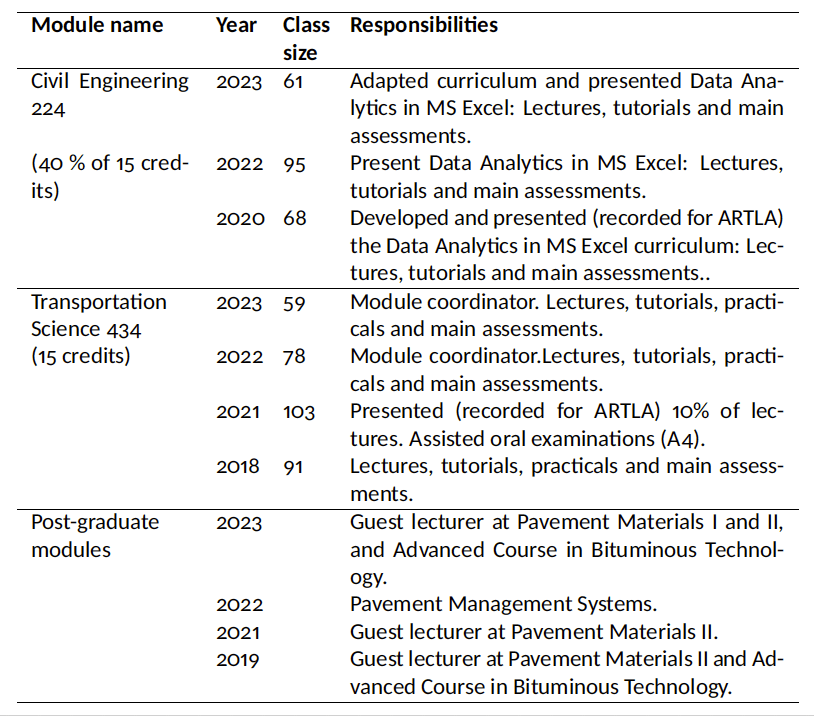
I have been lecturing ad-hoc since 2018, and full-time since 2021. My module-based lecturing comprises Transportation Science to 4th-years and the Data Analytics unit of Civil Engineering to 2nd-years. Transporation Science teaches students about pavement engineering – the materials, design, construction and maintenance. Data Analytics introduces students to the preprocessing, analysis and representation of civil engineering data in MS Excel. Additionally, I supervise 4 to 5 final year undergraduate research projects per year.
Teaching Context
Limited literature discusses contextual factors influencing the quality of higher education in South Africa [1]. The figure below indicates selected factors that influence how I approach supervision, teaching and module curriculum development. For me, these factors contextualising higher education can be grouped into the three pillars of project management:
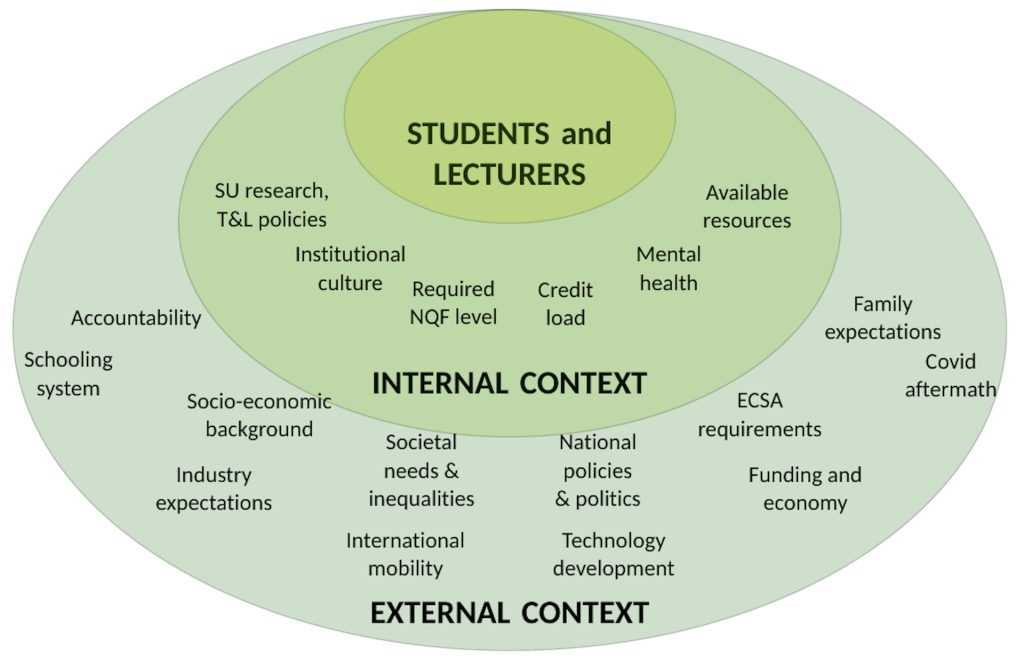
- Time: The available time is mostly influenced by internal factors such as the credit and teaching loads, and timetables. Personal and external factors, such as family commitments and requirements, may decrease productivity and increase demands on our time.
- Cost: The resources available – number of lecturers, technology infrastructure, and funding available to the students, as well as home infrastructure and support.
- Scope: Quality. Three things need to be defined here – (i) where we are, (ii) where we want to go and (iii) how we want to get there. Most aspects shown speak to this:
- Where we are: The socio-economic and schooling background of our students, the expectations and support from their families, their and our mental health and previous experiences, and the aftermath of COVID-19 and its influence on all of the above.
- Where we want to go: NQF and ECSA requirements, technical competencies and soft skills expected by the industry, institutional definitions of student success, and graduate engineers that speak to societal expectations and needs. Our module content should be purposefully designed to achieve these.
- How we want to get there: SU policies [2;3], and the institutional culture and management style. Do we want to implement technology developments and innovation (e.g. AI), or include international perspectives and competencies (e.g. sustainable development goals)? How much of where we want to go do we address, and how much is up to the student?
Regarding the interaction between the pillars, it has been my experience that time and cost constraints limit quality. Although academics have academic freedom at SU [2], it is grossly determined by whether the funding or the time can be found to think and explore laterally – whether that is related to our research or the quality of graduate engineer we would like to deliver. Under these limitations, it is essential to work focused, efficiently and effectively to attain the best quality we can with available resources – and, just enough adversity can breed resilience [4;5].
Furthermore, I firmly believe in the phrase, you can do anything, not everything. The demands of teaching on my time have made me appreciate the demands on our students’ time [6]. I remind myself that lecturing is a career – each year, I can build on the previous and improve another aspect. When planning, developing or renewing module content or helping a student identify the scope of their research, I identify the most important concepts (i.e. where we want to go) and prioritise their inclusion based on the available time (i.e. credit load).
Students Context
The where we are related to students requires flexibility from lecturers, as it may fluctuate depending on changes in the school curriculum, availability of bursaries to lower socio-economic families, and internationally significant events such as COVID-19. In one of my 1st years of lecturing, I received the advice, Remember to make your exams easier each year – not because students become less, but because you become more capable. Although it was said in jest, I see some truth in this. As lecturers, the repetition in module content may cause us to underestimate complexity creep. Benchmarking against previous years, moderation, and even rotating modules with other lecturers may mitigate this complication and the effects thereof on the students.
Further external factors may play a role in students’ learning, largely due to differences in exposure and experience. I manage these as follows:
- Language differences: Although aspects of culture and identity are embedded in language, I see the purpose of language as to communicate effectively. In my experience, tuition language is not the issue that the media portrays [7;8]. Following SU’s language policies, I primarily teach in English and, post-COVID, have had no issues raised by students. Most Afrikaans students prefer English lectures and even ask questions in English. Some switch to Afrikaans when they struggle. Students from other minority groups have not expressed discontent – although I encourage all students to engage. I do, however, appreciate lecturers in my department who speak isi-Xhosa as their home language, as I think this creates more open platforms for students to communicate their obstacles. %I have some learning in isiXhosa but in a non-technical context.
- Socio-economic (and schooling) differences: I clearly remember the moment I was explaining how to reference a cell in my 1st in-person tutorial for Civil Engineering 224 (Data Analytics). Some of the class looked bored, some unaffected, and the others were so gob-smacked that I had to explain it three times. To me, these differences represent the where we are, and trying to get everyone on the same page often leads to steep learning curves that some students can cope with and others cannot.
- Cultural differences: I believe this is the origin of most frustrations on the SU campus – tolerance for the different. Whether that be concerning language, culture or socio-economic background. We (i) have a responsibility to teach our students more than the technical [9], (ii) are a reflection (microcosm) of the society we represent. In this aspect, I try to be an example to my students, treating all students fairly and empathetically.
- Women in STEM: We live in a world where women are strongly encouraged to pursue careers in STEM – sometimes without proper consideration of whether it suits them or without the necessary support to help them navigate male-dominated environments [10]. I enjoy assisting graduates, and more so female graduates, to find their space in Civil Engineering.
- Mental health challenges: As an engineering student at SU, I was not aware of many students who were on prescription medication to cope with academic stress, but as a lecturer, I am shocked at the number of students that (i) are booked off due to mental health, (ii) have extra time due to learning difficulties, or (iii) only ask for help after the ship of their academic success has sailed, metaphorically.
These challenges and differences above raise the issue of how much support do we give and how much is up to the student? The Engineering Faculty has the Extended Degree Programme, counselling sessions, Tools for Academic Success course, departmental mentoring, and the South African Institute for Civil Engineers (SAICE) student chapter to assist students. SU has counselling services, residential mentoring, transformation committees, and special task teams to identify underlying institutional shortcomings, e.g. the Khampepe report. Lecturers are not therapists, but we can be aware, show appropriate empathy, and point students in the right direction [11].
Student Development
Student development is one of my primary sources of job satisfaction. I love challenging them and seeing how they discover they are capable of more than they thought [12]. To practically terrace student competency (quality), one needs to be realistic about what to expect from which year of graduate. NQF levels provide guidance [13;14;15;16]. When fewer new, fundamental concepts are introduced, more time can be spent exploring applications and innovative, internationally relevant topics. As NQF levels increase, more self-study may be expected. Generally, I plan according to the following guidelines:
- Assessments: mostly (50-70%) lecture and tutorial-based, some (20-30%) self-study, and the exception (5-15%) more advanced concepts, interpretation of calculations, or unseen, applied concepts. The weighting depends on the required NQF level, module outcomes and the position in the module chain during studies.
- 1st to mid 2nd-year: Mostly focussed on theoretical background – students should write out most steps during tutorials and assessments to show insight into the fundamental concepts. During the Data Analytics unit of CE 224, we migrate from this stage of learning towards the next. Students learn to analyse and visually represent Civil Engineering data in MS Excel. A small portion of assignments (< 5%) expect students to interpret the data they represent logically.
- mid 2nd-year to end of 3rd-year: The transition to practical knowledge. Concepts are more applied, and student assessments can be as well. Tutorials and assessments can include questions to be completed in calculation tools such as MS Excel and other software. I do not teach at this level, but this is where I expect to meet my students when I receive them in 4th-year.
- 4th-year: The tutorials and assessments should be scaffolded to reach independent thinking and applied methods. In Transportation Science 434, the students are introduced to pavement engineering for the first time. We spend half of the semester learning about the applicable fundamental material properties and then transition into how that feeds into pavement design, construction and management. To an increasing degree, we challenge the students to become more comfortable with engineering assumptions based on their acquired knowledge.
- Final year projects: The students are inexperienced when structuring the reports and research approach. I tend to provide them with examples of good documents and general good practice guidelines upfront. I have formulated my FYP topics for the past year to slot into MEng topics. This gives deeper context and creates a team environment for the FYP students. By assisting in managing the FYP, the MEng student grows in their abilities. I also believe the FYP is an excellent place to further students’ thinking regarding the ethical use of AI. My agreement with students is that they may use it to understand the basics of concepts (similar to googling or using Wikipedia) and to correct their language (similar to Grammarly). However, the intellectual analysis and assimilation of concepts should be their own.
- MEng: Generally, my students focus their 1st-year on literature reviews and courses, and starting their testing. The 2nd is spent completing testing, data analysis and their theses. In some cases, testing may come first primarily due to industry involvement. I strive to balance being involved and allowing them to find answers for themselves. Students’ personal goals may further influence how far I push students during research supervision – if a student expresses the intent to Cum Laude, I expect more of them than from others, e.g. I am more critical when reviewing their documents and asking questions regarding their understanding.
Personal Development
I remember the picture I drew in the 1st grade about what I wanted to be as a teacher. I believe that even at that age, I had fallen in love with the process of understanding, of learning how to. I regularly helped classmates with concepts in high school, particularly in mathematics. I learnt to approach topics from different angles depending on the person’s interests. Figuring out which approach would lead to the light-bulb moment gave me satisfaction similar to solving complex geometry or trigonometry problems. Without knowing what I wanted to study, I considered either completing a PGCE (Post-Graduate Certificate in Education) and teaching, or a PhD and becoming a lecturer.
While completing my degree, there were two distinct instances where I thought I had made the wrong decision to study engineering. I felt slightly cheated by a world increasingly encouraging young women to pursue careers in STEM because they are good at science and mathematics – I had also been good at languages and art. This feeling lingered while I was working in an engineering design office. My work lacked instances of complex problem-solving and mainly consisted of administrative tasks. Only when I moved to site supervision did engineering engage me. Getting my hands dirty, working with people from all walks of life and getting to know myself in the unknown helped me realise that I would be unhappy in any career when I stopped learning. I also had the opportunity to oversee the in-service training of students from CPUT and found joy in their learning. That was the start of realising that I needed people and mathematics – purposeful interaction and analytical thinking.
The opportunity to complete a full-time Master’s presented itself. In one of the first weeks back on campus, I attended a welcome lecture by Prof Eugene Cloete. In it, he relayed a story about a mathematics lecturer who used scare tactics (the number of students that would fail) to encourage students to work hard. It had the opposite effect, as students felt dejected and incapable. Prof Cloete instead stressed the importance of your mindset towards challenging subject matter and asked us to approach everything as if we could understand it. The message resonated with me. It has always made me sad when someone dislikes mathematics because their teacher made them feel inadequate and unintelligent. I believe this moment has impacted how I engage with my students – encouraging them that they can understand anything they put their minds to.
While completing my post-graduate education, I taught Admaths to high school learners. The smaller classes worked well when they were more interactive – it helped gauge to which degree the learners had grasped a concept [17]. Working with above-average learners was highly satisfying, but I noticed that culture (and language) affected how the students interacted with me. I experienced that the Afrikaans students were more reserved in conversational-type interaction about the lesson content, whereas the English learners quickly became comfortable raising uncertainties, clarifications or even disagreements. Culture further became a consideration as I became more involved with lecturing. Students from minority cultures often appear side-lined and less inclined to engage openly in class conversations. I do believe that there are active choices a lecturer can make to be more approachable to these students. For example, I use tutorials and practical sessions to network with the students and be proactive in establishing lines of communication with them. One such student interviewed me for complementary studies later and mentioned that it had made an impression on him. This feedback has encouraged me to continue encouraging students to engage in class.
A Master’s turned into a PhD and lecturing opportunities. During this time, I spent a semester at TU Delft in the Netherlands, completing post-graduate modules. It was striking to experience the level of independence expected from students after a 3-year BEng. Only vital concepts are presented in class. Self-study is the norm for preparation for tutorials and examinations. It starkly contrasts my local experience that students are caught off guard when exam content is not a majority copy-paste from tutorial questions. I wonder if we in the engineering faculty too often enable students to become lazy learners. In response, I have purposefully established boundaries when interacting with students. Instead of giving the answers during tutorials, I prefer to ask questions to their questions to guide their thinking. I also prefer students to ask questions in classes and online forums – in this way, all students can benefit from the Q&A. It avoids situations where students email lecturers without thinking about the problem for themselves. In the future, I would like to learn how to enable students to be independent learners in a more structured manner.
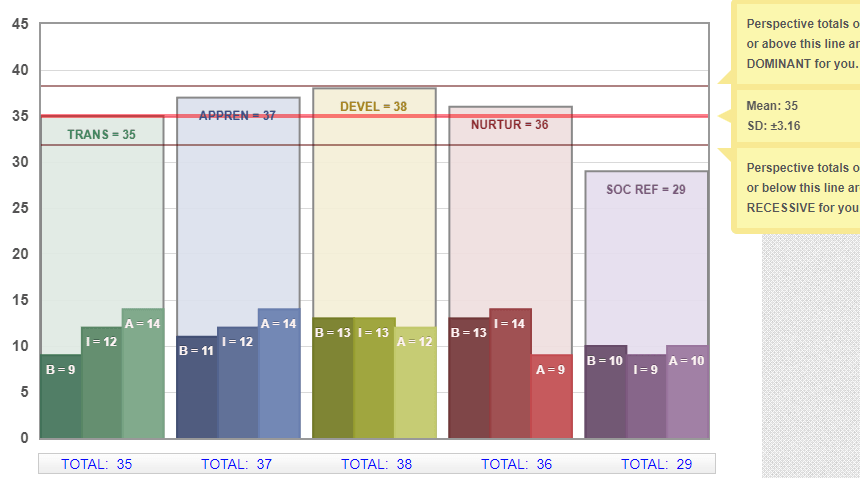
My teaching outlook has been shaped by the experiences that led me to lecture, but it has also grown significantly since my appointment in 2021. I now realise teaching can be more intentional – even for someone naturally attracted to it. The figures below indicate the changes in my Teaching Perspective Inventory from 2022 (left) to 2023 (right). Although my dominant perspectives have note changed, I can see changes in my beliefs, intents and actions. I believe the changes in intent and actions may be due to more realistic expectations of what can be achieved in the time available and a better understanding of what the students require from me to learn. I am curious to see how these develop over the course of my career.

The Professional Educational Development of Academics (PREDAC) course, discussions with other lecturers and mentoring have played a role in my development. I have learnt to critically evaluate whether my intent and actions align – that I cannot expect results if I do not plan for them. Official student feedback, although generally positive, is based on few respondents. When deciding whether changes are necessary, I supplement these by asking students in class and tutorials how they experience learning opportunities.
Most recently, challenges were experienced with Data Analytics. Students generally felt a high demand for their time and a significant jump in difficulty between the 1st and 2nd terms. Additionally, the 2nd-year marks dropped post-ARTLA (Augmented Remote Teaching, Learning and Assessment). The lecturers had a candid discussion with class representatives, and one of the shortcomings identified was that students underestimated how much was expected of them. As a response, I dedicate the introductory lectures to highlighting the content and expectations from the module guide explicitly. Our first tutorial is also a time-management exercise where students use the credit loads from the yearbook to draw up a table and calculate how many hours a day the average should be spending on course-related work.
In 2023, following a critical module content evaluation exercise, the Data Analytics module content was also reduced, omitting the macro and VBA portions. However, the change in marks was marginal. Fund for Innovation and Research into Learning and Teaching (FINLO) funding has subsequently been secured to re-evaluate and redesign the content and mode of presentation. The projects aims to engage with staff, students, industry and recent alumni to determine (i) current student exposure to data analysis, (ii) industry requirements, and (iii) possible gaps between the two, and then develop or curate online content specific these needs.
Teaching Philosophy Statement
My teaching philosophy can then briefly be summarised as exploration. Exploration of self, community, knowledge, and the process of learning. I am idealistic about learning and believe it should be developmental. It is the process of understanding the fundamentals of a principle to have the correct tools to analyse a complex problem. To this end, I view my role as a facilitator – not just answering questions but encouraging students to find it for themselves by pointing them in the right direction.
I maintain learning is more meaningful when it’s practical. Based on my experience, I most likely would have left engineering without the opportunity to work on a construction site. Therefore, I incorporate practical and do-it-yourself opportunities for students as much as possible. These sessions are often completed in groups – further creating moments of peer-to-peer learning. Purposefully creating opportunities to have discussions in smaller groups helps develop students’ sense of belonging and ownership.
I consider myself responsible for contributing towards social cohesion through how I interact with my classes and students individually. Although I am nurturing by nature, it must be balanced with boundaries. These are critical to enabling students to take responsibility for their learning. For me, boundaries are enforced by when and how communication is facilitated. I put in the effort to ensure students view me as accessible, but I have also realised that I am responsible for teaching them what appropriate communication is.
What would I say to students about my teaching philosophy? Learning is for you. It makes your life better. You are its author, and you are responsible for deciding how to engage with it. You determine its purpose. I am here to facilitate, guide and advise. I am here to listen and learn how to do this better, but I cannot know for you. I only have the privilege of witnessing your growth through learning as I have grown through it.

References
[1] Holtzhausen, S.: External and internal influences on the development and implementation of quality assurance in higher education institutions. South African Journal of Higher Education, vol. 14, pp. 118–125, 11 2000. ISSN 1011-3487.
[2] Stellenbosch University: Vision and mission 2040. Available at: http://www.sun.ac.za/english/about-us/strategic-documents
[3] Stellenbosch University: Recommended engineering educational practices (REEP). 2023. Available at: https://sites.google.com/view/reep-engineering-education/home
[4] Seery, M.D., Holman, E.A. and Silver, R.C.: Whatever does not kill us: Cumulative lifetime adversity, vulnerability, and resilience. Journal of Personality and Social Psychology, vol. 99, pp. 1025–1041, 12 2010. ISSN 00223514.
[5] Big Think: Just enough adversity breeds resilience. 2011. Available at: https://bigthink.com/personal-growth/just-enough-adversity-breeds-resilience/
[6] Kolari, S., Savander-Ranne, C. and Viskari, E.L.: Do our engineering students spend enough time studying? European Journal of Engineering Education, vol. 31, pp. 499–508, 10 2006. ISSN 14695898. Available at: https://www.tandfonline.com/action/journalInformation?journalCode=ceee20
[7] Qionot, G. and Liebenberg, S.: Report on Stellenbosch University language issue flawed. News 24, 3 2023. Available at: https://perma.cc/56VR-B5NP
[8] Seyisi, T.: Elements masquerading as language activists are damaging the reputation of Stellenbosch University. Daily Maverick, 2023. Available at: https://web.archive.org/web/20230829103228/https://www.dailymaverick.co.za/opinionista/2023-03-23-elements-masquerading-as-language-activists-are-damaging-the-reputation-of-stellenbosch-university/
[9] International Engineering Alliance, I.E.: Graduate attributes and professional competencies. 2021. Available at: https://www.ieagreements.org
[10] Ministerial Oversight Committee on Transformation in the South African Public Universities (TOC): The state of transformation in South Africa’s public universities. 2023. Available at: https://web.archive.org/web/20230829103808/https://helm.ac.za/wp-content/uploads/2023_State_of_Transformation_in_Universities_TOC-DHET_FULL_REPORT.pdf
[11] Korsten, N., Wolff, K. and Booysen, M.J.: Time for mentally healthy engineering students. Proceedings of 2021World Engineering Education Forum/Global Engineering Deans Council, WEEF/GEDC 2021, pp. 101–109, 2021.
[12] Al-Jayyousi, O.: Introduction of lateral thinking to civil and environmental engineering education. International Journal of Engineering Education, vol. 15, pp. 199–205, 1999.
[13] Task Team on Undergraduate Curriculum Structure: A proposal for undergraduate curriculum reform in South Africa: The case for a flexible curriculum structure. 2013.
[14] Council on Higher Education: The higher education qualifications sub-framework. 2013.
[15] Stellenbosch University: NQF levels of a qualification: Higher education sub-framework (HEQSF). 2022.
[16] Wolff, K. and Clarence-Fincham, J.: New generation extended curriculum programmes: Report to the DHE. 2016. Available at: https://www.researchgate.net/publication/302926675
[17] Smith, K.A., Sheppard, S.D., Johnson, D.W. and Johnson, R.T.: Pedagogies of engagement: Classroom-based practices. Journal of Engineering Education, vol. 87, 2005. Available at: https://web.archive.org/web/20230829103850/https://onlinelibrary.wiley.com/doi/10.1002/j.2168-9830.2005.tb00831.x
 Elaine Simone Goosen | PhD